TR-830 Entry Register
Introduction/Purpose
The TR‑830 Entry Register is the official customs and trade record used to account for the entry of petroleum products (white oils such as petrol, diesel, kerosene, Jet A1) into bonded warehouses, depots, or terminals in Kenya.
It acts as a stock inflow register tied to the customs bond (TR‑800). In practice, TR‑830 confirms that the product not only has a bonded customs declaration (TR‑800) but has also physically entered a licensed bonded facility.
Purpose & Regulatory Context
- Purpose
• Document quantities of oil or white products (e.g. Mogas, Diesel, Jet A-1, DPK) that physically enter your bonded facility.
• Tie each receipt back to the bond declaration (TR-800) for accurate bond-balance tracking.
• Supply Kenya Revenue Authority (KRA) with an auditable register of bonded stock movements. - Regulatory Basis
• East African Community Customs Management Act (EACCMA)
• KRA Bond Regulations for Petroleum Products
• Customs Bonded Warehouse Guidelines
Where It’s Used
- Ports of Entry:
Mombasa Port, Lamu Port, Nairobi ICD (inland terminal via pipeline). - Bonded Storage Locations:
Petroleum depots, Oil Marketing Company (OMC) terminals, pipeline-connected storage tanks. - Trading & Customs Systems:
Integrated into trade modules (like Rockeye Trade), linked to TR‑800 and TR‑812.
Who Uses TR-830 & When
- Who
– Bonded-warehouse operators, terminal managers, clearing agents, and importer logistics teams. - When
– Immediately upon discharge of each shipment into a bonded tank or warehouse.
– Before any downstream processing (mixing, blending) or onward transfer (TR-812 Exit Register).
How To Navitage
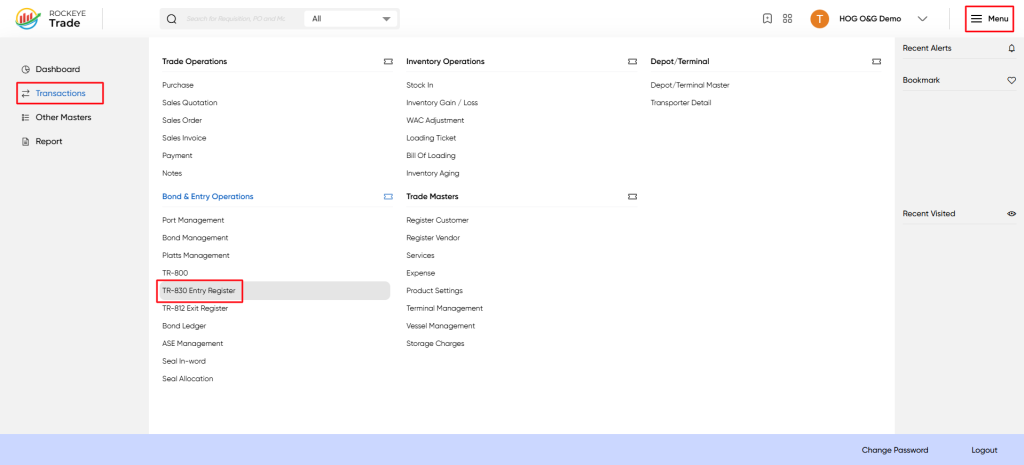
From the left menu, click Transactions → Bond & Entry Operations → TR-830 Entry Register.
Listing
TR-830 (Entry Register List)
- Displays all registered entries.
- Key fields include:
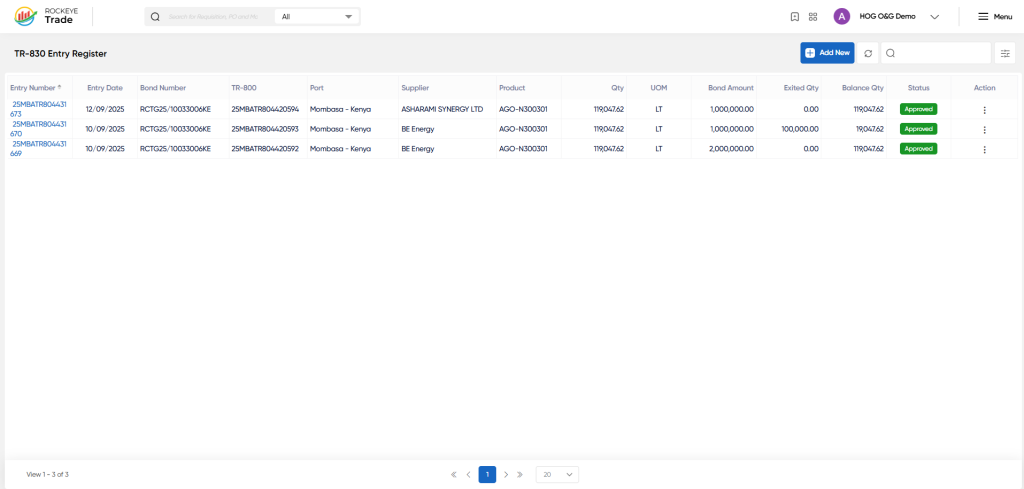
- Entry Number – Unique ID for record.
- Entry Date – When stock officially entered bond.
- Bond Number – Customs bond reference (linked with TR-800).
- Port – Port of import (Mombasa, Nairobi ICD, Lamu, Malindi).
- Supplier – Oil marketing company (e.g., KPC Limited, Gulf Express).
- Product – Type of petroleum imported (MSP, AGO, Jet A1, DPK).
- Quantity – Volume received.
- UOM – Unit of measure (e.g., LT, MT, M³).
- Bond Amount – Declared bond value under KRA.
- Exited Qty – Quantity already cleared/removed.
- Balance Qty – Remaining stock in bond.
- Status – Approval state (Approved / Pending).
How To Add TR-830 Entry Register
Creating a New TR-830 Entry
Click “Add New” to open the TR-830 entry form.
This form allows you to log detailed entry information for oil imports.
TR-830 Entry Form Fields Explained
When adding a new entry, the following details are required:
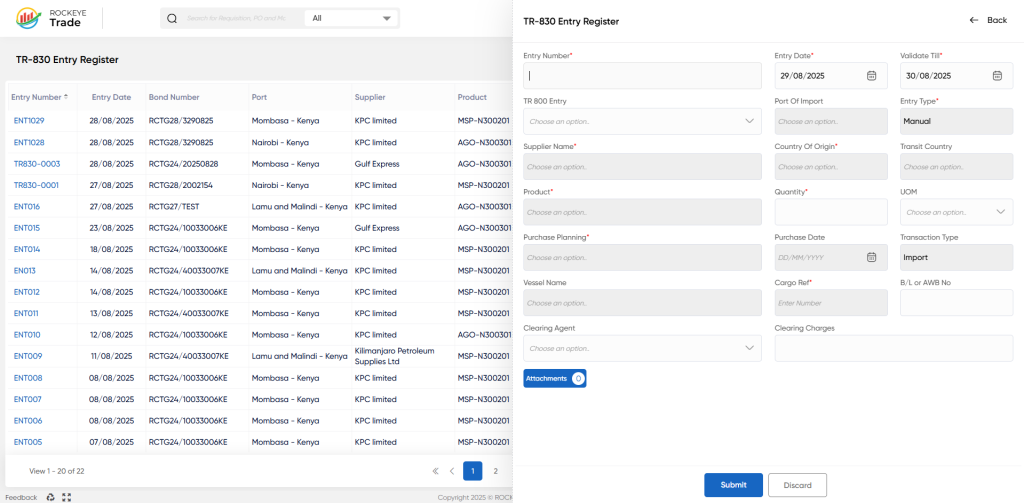
- Entry Number* – Auto-generated or manually input identifier.
- Entry Date* – Actual date cargo entered bond.
- Validate Till* – Specifies expiration of entry record validity.
- TR-800 Entry* – Links TR-830 to a TR-800 declaration.
- Port of Import* – Select the terminal/port (e.g., Mombasa – Kenya).
- Supplier Name* – Vendor/OMC.
- Country of Origin – Where petroleum was sourced.
- Transit Country – Any transit nation if applicable.
- Product* – Select oil product (MSP, AGO, Jet A1, DPK).
- Quantity* – Volume received.
- Unit of Measure (UOM)* – Liters (LT), Metric Tonnes (MT), Cubic Meters (M³).
- Bond Amount – Customs-declared value of product.
- B/L or AWB No – Bill of Lading (sea freight) or Airway Bill number.
- Purchase Planning & Date – Links with procurement planning.
- Vessel Name – Ship delivering the cargo.
- Cargo Reference – Cargo ID / shipping reference.
- Clearing Agent & Charges – Customs clearing agent and related fees.
- Attachments – Upload supporting customs/shipping docs.
- Click Submit → Entry is saved and moves to the Dashboard view.
- Click Discard → Cancels data entry.
- Once approved, the entry becomes part of the official bond register and is linked directly to reporting & exit movements.

