Entity Module Mapping
Introduction/Purpose
This document serves as a vital component of the Complete Solution Guide: ROCKEYE – Trade Solution, focusing on providing a comprehensive Entity Module Map diagram for the ROCKEYE – Trade System. Its primary aim is to visually delineate and clarify the diverse interactions and activities available to users within the system. The Entity Module Map diagram acts as a crucial aid in understanding the sequence of actions, relationships between different entities, and the overall functionality of the Trade System from a user-centric viewpoint.
Clarity in User Interactions: Illustrate the step-by-step process through which users engage with the Trade System, offering a clear visual representation of the sequence of actions executed by users.
Identification of User Roles: Define distinct user roles within the system, including OMC Manager, OMC Officer, Finance Officer and Depot Manager, while highlighting the specific activities associated with each role.
Highlight System Features: Showcase the functionalities available to users, emphasizing key features such as Sales & Purchase Management, Inventory management, Bond Management, Customs entry handling, ASE Compliance Management and reporting to enhance understanding.
Enhance User Training: Incorporate pathways and decision points addressing potential errors or exceptions that users may encounter. Clarify error-handling mechanisms and guide users on navigating such situations effectively.
Entity Module Map diagram
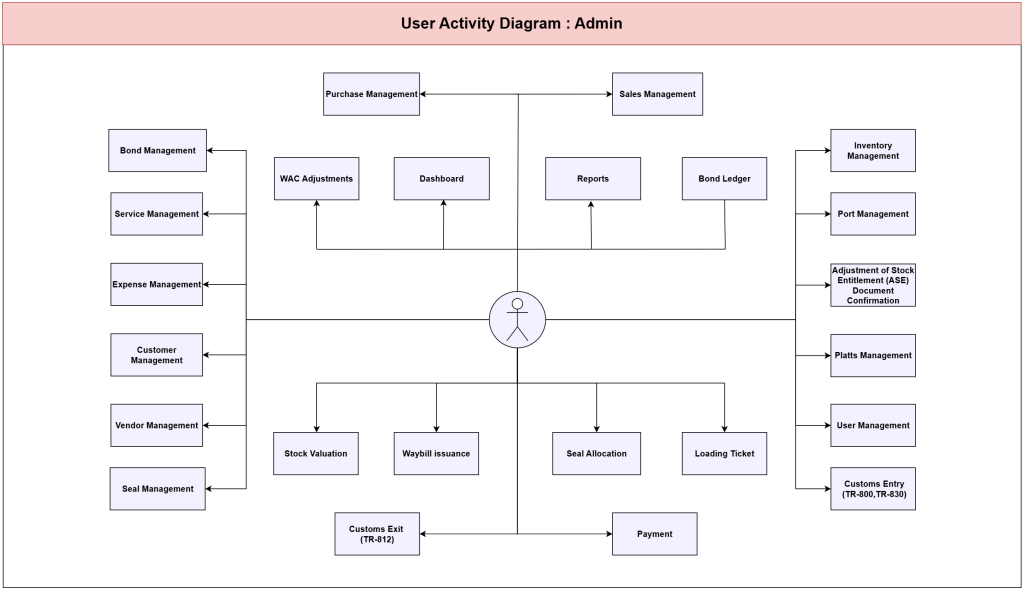
Admin
Role(s): The Admin oversees and manages all core trade module processes and system functions, spanning purchase/sales workflows, inventory and port operations, user and bond management, and system-wide adjustments and reporting.
- Oversee Inventory Management to ensure accurate tracking of deliveries, shipments, and stock levels
- Manage Port Management to streamline import/export logistics and facilitate efficient cargo handling.
- Coordinate Adjustment of Stock Entitlement (ASE) Document Confirmation to ensure accurate adjustment and compliance of stock entitlements.
- Administer Platts Management to maintain up-to-date commodity price references within the system.
- Manage User Management to control system access, configure user permissions, and secure trade operations.
- Process Customs Entry (TR-800, TR-830) filings to comply with import regulations and streamline clearance.
- Issue Waybill issuance to authorize and document shipments for each dispatched order.
- Manage Seal Allocation to ensure secure tracking of product movement through controlled seal assignment.
- Generate Loading Ticket to document cargo loading events and maintain accurate shipment records.
- Perform Stock Valuation to assess inventory value and support financial reporting.
- Process Customs Exit (TR-812) documentation to complete export procedures and regulatory compliance.
- Manage Payment processing to ensure timely settlement of trade-related financial transactions.
- Oversee Purchase Management to coordinate procurement processes and ensure timely inventory replenishment.
- Manage Sales Management to streamline order processing, fulfillment, and revenue tracking.
- Monitor the Dashboard to track key performance metrics and operational status in real time.
- Generate Reports to provide actionable insights and analytics on trade operations and inventory.
- Maintain the Bond Ledger to track bonded inventory transactions and related financial obligations.
- Implement WAC Adjustments to maintain accurate inventory costing and support cost accounting.
- Oversee Bond Management to handle bonded goods and ensure regulatory compliance.
- Coordinate Service Management to handle customer and vendor service requests and support activities.
- Oversee Expense Management to control and report trade-related costs and expenditures.
- Manage Customer Management to maintain customer accounts, profiles, and relationship data.
Manage Vendor Management to maintain supplier accounts, performance, and contract data. - Administer Seal Management to oversee issuance and tracking of security seals.
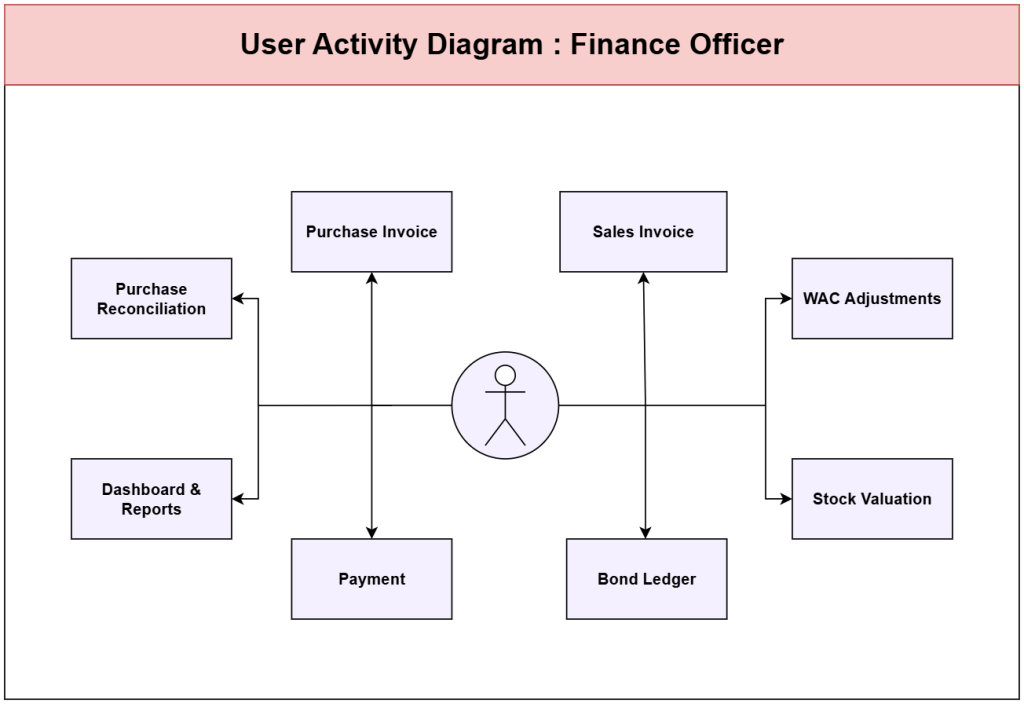
Finance Officer
Role(s): The Finance Officer handles all financial accounting processes within the trade module, including invoicing, reconciliation, payments, and ledger management.
- Oversee Purchase Reconciliation to ensure invoices, purchase orders, and payments are accurately matched and verified.
- Monitor the Dashboard & Reports to analyze key financial metrics, trends, and performance.
- Process Purchase Invoice entries to validate and record procurement expenses in the accounts.
- Manage Payment processing to ensure timely disbursement of funds and vendor settlements.
- Generate Sales Invoice documents to record revenue and support accounts receivable tracking.
Maintain the Bond Ledger to track financial transactions related to bonded inventory and obligations. - Implement WAC Adjustments to ensure inventory costs are accurately reflected in financial records.
- Perform Stock Valuation to reconcile inventory values and support accurate financial reporting.
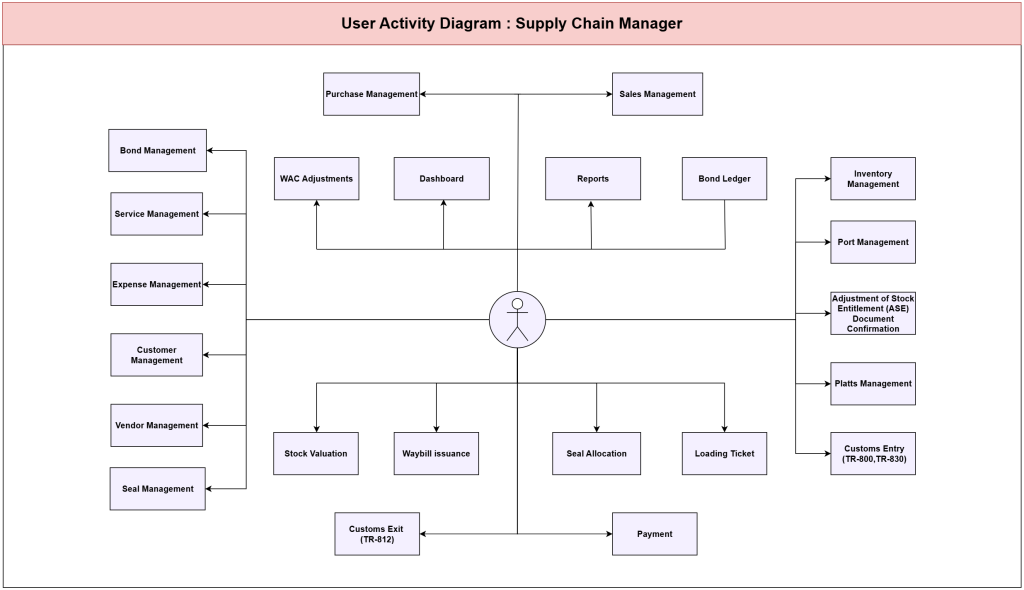
Supply Chain Manager
Role(s): The Supply Chain Manager oversees supply chain operations across procurement, logistics, inventory, and related reporting processes in the trade system.
- Oversee Inventory Management to maintain optimal stock levels and visibility across all locations.
- Coordinate Port Management to optimize import/export processes and minimize port delays.
- Approve Adjustment of Stock Entitlement (ASE) Document Confirmation to ensure accurate stock adjustments.
- Manage Platts Management to keep commodity pricing data current for supply chain decisions.
- Manage Customs Entry (TR-800, TR-830) processes to ensure compliance with import regulations and timelines.
- Issue Waybill issuance to track and authorize each shipment for downstream processing.
- Manage Seal Allocation to secure shipments by assigning unique seals to loads and containers.
- Prepare Loading Ticket documents for accurate recording of cargo loading operations.
- Perform Stock Valuation to assess inventory worth and inform procurement strategies.
- Oversee Purchase Management to coordinate procurement activities and maintain stock availability.
- Manage Sales Management to streamline order fulfillment and coordinate deliveries.
- Monitor the Dashboard to track real-time operational metrics and performance indicators.
- Generate Reports to provide insights into supply chain activities, inventory status, and KPIs.
- Maintain the Bond Ledger to track bonded goods and related financial entries.
- Implement WAC Adjustments to ensure inventory is accurately costed for accounting.
- Oversee Bond Management to handle bonded shipments and regulatory requirements.
- Coordinate Service Management to handle vendor services and maintenance tasks supporting the supply chain.
- Oversee Expense Management to control supply chain-related costs and budget adherence.
- Manage Customer Management to maintain customer account data and support client relations.
- Manage Vendor Management to oversee supplier relationships and performance.
- Administer Seal Management to oversee issuance, assignment, and tracking of security seals in logistics.
- Manage Payment processes to facilitate timely trade transaction settlements.
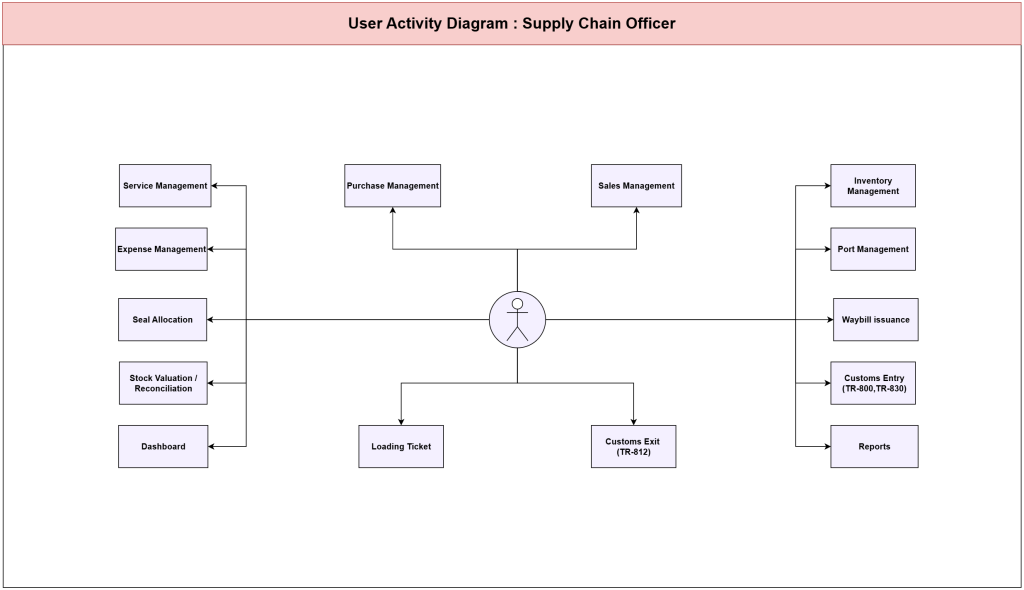
Supply Chain Officer
Role(s): The Supply Chain Officer executes day-to-day supply chain tasks, managing procurement and sales activities as well as inventory, port, and logistics documentation.
- Coordinate Service Management to handle trade-related service requests and vendor services.
- Manage Expense Management to monitor and control operational expenditures in the supply chain.
- Manage Seal Allocation to ensure secure tracking of goods through controlled seal usage.
- Perform Stock Valuation to reconcile inventory levels and values for operational reporting.
- Monitor the Dashboard to review key operational metrics and alerts.
- Oversee Inventory Management to maintain accurate stock counts and availability.
- Coordinate Port Management to facilitate efficient import/export operations and scheduling.
- Issue Waybill issuance to authorize shipments and generate necessary transport documentation.
- Prepare Customs Entry (TR-800, TR-830) filings to comply with import regulations and requirements.
- Generate Reports to document trade activities and performance for review.
- Assist in Purchase Management activities to support procurement and inventory needs.
- Assist in Sales Management activities to support order processing and customer fulfillment.
- Prepare Loading Ticket documents for accurate recording of cargo loading events.
- Process Customs Exit (TR-812) filings to support export compliance and clearance.